
Before we say grace
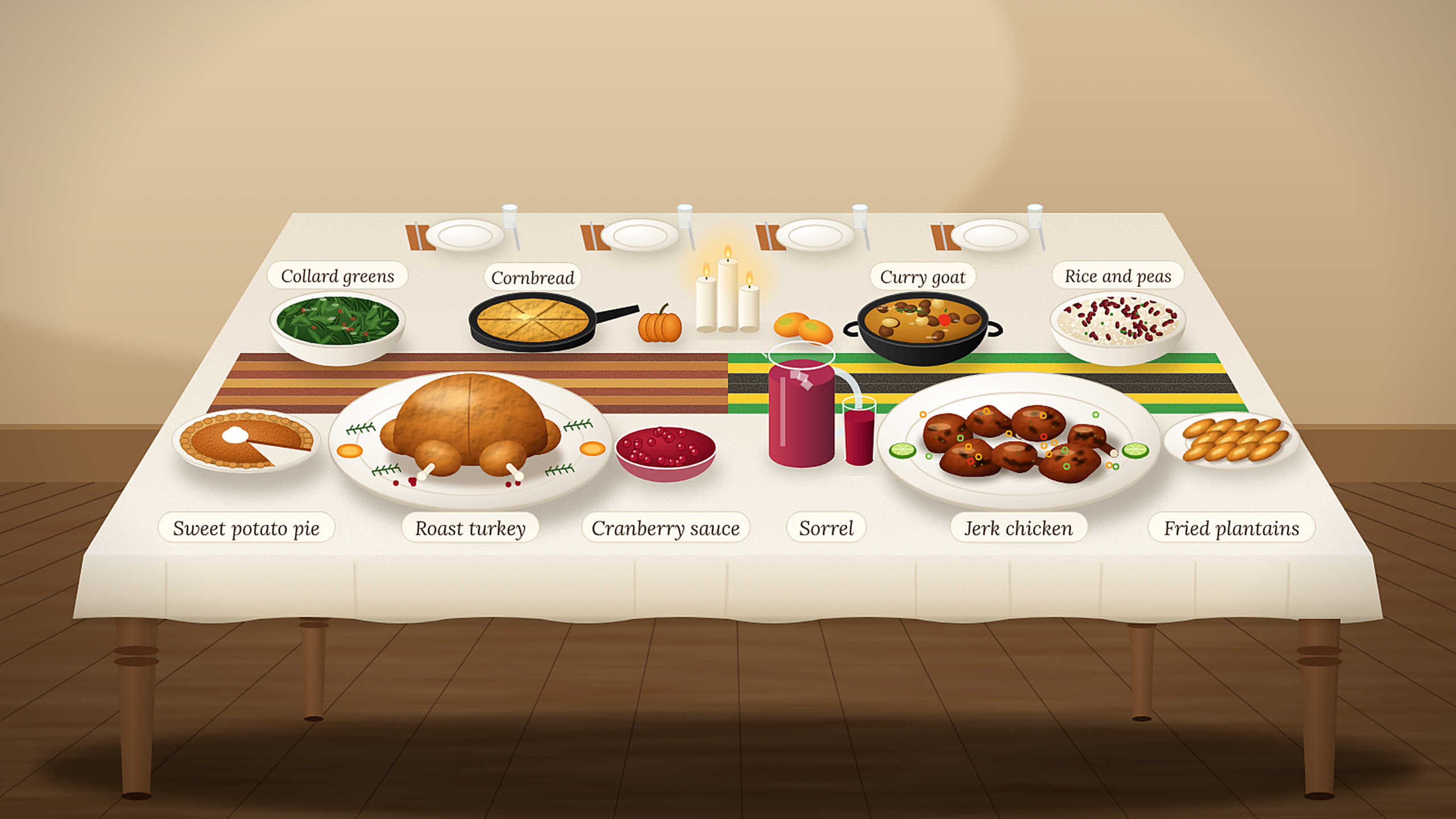
Every Thanksgiving table tells a story about who feeds us. At ours, the turkey and collard greens sit beside jerk chicken and rice and peas. There’s sweet potato pie and cornbread, curry goat and fried plantains, and a cold pitcher of sorrel. Two traditions, one table; U.S. and Jamaican Thanksgiving dishes side by side.
Most of these dishes started in someone’s garden or field. Many trace back to people who have grown food in this country with the least recognition: Indigenous nations who grew corn, beans, and squash; Black farmers who carried greens, okra, and sweet potatoes through slavery, sharecropping, and land loss; and immigrant growers who planted the foods of home.
So this year, before we say grace, I want to ask a harder question. Who grew this food? Who benefits from it? And why does so much of that work go uncounted?
Who feeds us
The people who grow our food are mostly small, often stretched thin, and largely invisible in the numbers.
Farmworkers. In 2024, hired farmworkers earned about $18 an hour, roughly 60% of what other workers earned. About four in ten crop workers lack work authorization. Most now live and work in one community. They are our neighbors, and without them there is no harvest to give thanks for.
Small family farms. They make up 86% of U.S. farms but produce just 17% of what gets sold. Most farm families earn the bulk of their income off the farm, which means many of them subsidize our food with a second job.
Black farmers. The number of Black-operated farms fell 8% between 2017 and 2022, and more than half sell less than $5,000 a year. Many of those farms sit on land that families fought for generations to keep.
Community growers. Then there are the backyard gardens, church plots, and mutual aid farms that grow food to share. A grandmother’s collard patch that feeds three households. A congregation’s acre that stocks the food pantry every Saturday. Almost none of what they grow is counted anywhere.
The harvest no one counts
Every summer, my big-tent family (my mom, my siblings, our kids, nieces, and nephews) eats a lot of mangoes. Not store-bought ones. They come in several varieties, from trees grown by members of our community, and they arrive by the shopping bag: four or five bags a season, about 100 pounds of fruit.
If we bought those mangoes at the supermarket, we’d pay somewhere between $200 and $280. We don’t. Instead, we share what we have. Pumpkins, white sweet potatoes, or yams from our garden go back the other way. Sometimes it’s a home-cooked meal, delivered to my sister’s friend at the hospital where she works, because she shared her mangoes with us. Nobody keeps a ledger. Everybody eats.
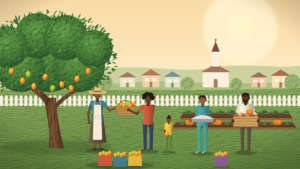
Nobody keeps a ledger: mangoes go one way, yams, pumpkins, and home-cooked meals come back.
That’s real food with real value moving between real households. But in the official picture of America’s food system, none of it happened.
Here’s why. USDA counts a place as a farm only if it sells, or normally would sell, at least $1,000 of agricultural products a year. That’s a low bar, but it’s the wrong one: it measures sales, not food. Our neighbors aren’t selling their mangoes, and we aren’t selling our yams. A bag of mangoes traded for a plate of dinner isn’t a sale, so it isn’t a number.
The U.S. has no working definition for this kind of growing. USDA’s own agricultural library describes subsistence farming as growing food mostly for your own household, but no federal survey measures it. A Congressional Research Service brief noted that the $1,000 rule may leave out community gardens, very small farms, and nonprofit farms. And what we don’t count, we rarely fund or protect.
It doesn’t have to be this way, and in much of the world it isn’t. The United Nations System of National Accounts, the global rulebook for measuring GDP, counts food that households grow for themselves as real production, and it counts produce traded by barter too. Australia’s national accounts include an estimate for “backyard production.” And UN-backed surveys of farming households are built to include anyone who works land regardless of the final purpose of production, orchards and kitchen gardens included. Much of the world already counts the mango tree that feeds a family. In the U.S., it mostly goes unrecorded.
Even the word “subsistence” gets in the way. To many Americans it sounds like barely getting by. That isn’t what happens around my family’s table. It’s abundance, shared. The growers I know call it mutual aid, food sovereignty, or simply taking care of our own.
Who grows, who benefits
So let’s give it a name: community provisioning agriculture. That’s food grown, raised, or gathered mainly to feed the grower’s household and community, and shared through gifts, trades, or donations rather than sold for profit.
It isn’t separate from commercial farming. It sits on a spectrum, and most growers move along it in a single season: eating some, giving some, selling some. A name matters, too. Programs, grants, and policies are built around categories. If a kind of farming has no name, it has no line in anyone’s budget.
| Type of grower | Where the food goes | Who benefits | Counted today? |
|---|---|---|---|
| Household: backyard gardens, fruit trees | The family table | The household | No |
| Community: church, pantry, and mutual aid farms | Neighbors, pantries, elders | The whole community | Rarely |
| Small mixed farms | Markets, plus what is shared | Local buyers, neighbors, the farm family | Partly: sales only |
| Commercial farms | Grocery stores, processors, exports | Shoppers, retailers, the business | Yes |
Running through every row are the farmworkers whose labor makes the harvest possible. Read the table from bottom to top and a pattern appears. The closer a grower is to feeding their community, the more of the value goes to other people, and the less of it our data can see. Those who give the most are counted the least.
Counting what we can
We don’t need a perfect number to start valuing this work. The U.S. Bureau of Economic Analysis already estimates the value of household production, unpaid work like cooking, child care, and gardening that never appears in GDP. The same logic works for food: pounds grown or shared, times what that food would cost at the store. Our mangoes come to $200 to $280 a season. Multiply that across a neighborhood, a congregation, or a county, and the numbers add up quickly.
Some things no number captures: fresh, culturally rooted food local stores may not stock, elders teaching children to grow and cook, and networks that show up in a crisis before any agency does. We count so that what we cannot count is protected, funded, and passed on.
From grace to action
Gratitude that stays at the table is a feeling. Gratitude that leaves the table is a practice. Here’s how to practice it:
- Ask the question. As the dishes go around, ask who grew them. Name the farmworker, the farmer, the neighbor with the mango tree.
- Spend where thanks is owed. Buy from small, Black, Indigenous, Latino, and immigrant farmers, and pay what the food is worth.
- Support farms that give food away. Pantry farms and mutual aid growers need seeds, tools, land, and operating money, not just volunteers in November.
- Start counting. If you lead a pantry, church, or garden, log pounds grown, pounds shared, and hours given. Small records become evidence.
- Push for a definition. Ask researchers, funders, and USDA to recognize community provisioning agriculture so its value can be measured and supported.
So when we bow our heads this year, let’s give thanks for the food, and then for the hands. And let’s leave the table determined that the people who feed us will no longer go uncounted.
Sources
- Farm Labor, USDA Economic Research Service, updated Nov. 18, 2025
- America’s Farms and Ranches at a Glance: 2025 Edition, USDA Economic Research Service, Feb. 2026
- Black Producers, 2022 Census of Agriculture Highlights, USDA NASS, June 2024
- Subsistence farming, NAL Agricultural Thesaurus, USDA National Agricultural Library
- Expanding Federal Support for Urban Agriculture, Congressional Research Service, Jan. 2017
- Household Production, U.S. Bureau of Economic Analysis
- Australian National Accounts: Concepts, Sources and Methods, Chapter 4: Production, Australian Bureau of Statistics, 2000 (archived)
- SDG Indicator 5.a.1 Metadata, UN Statistics Division and FAO, updated July 2024